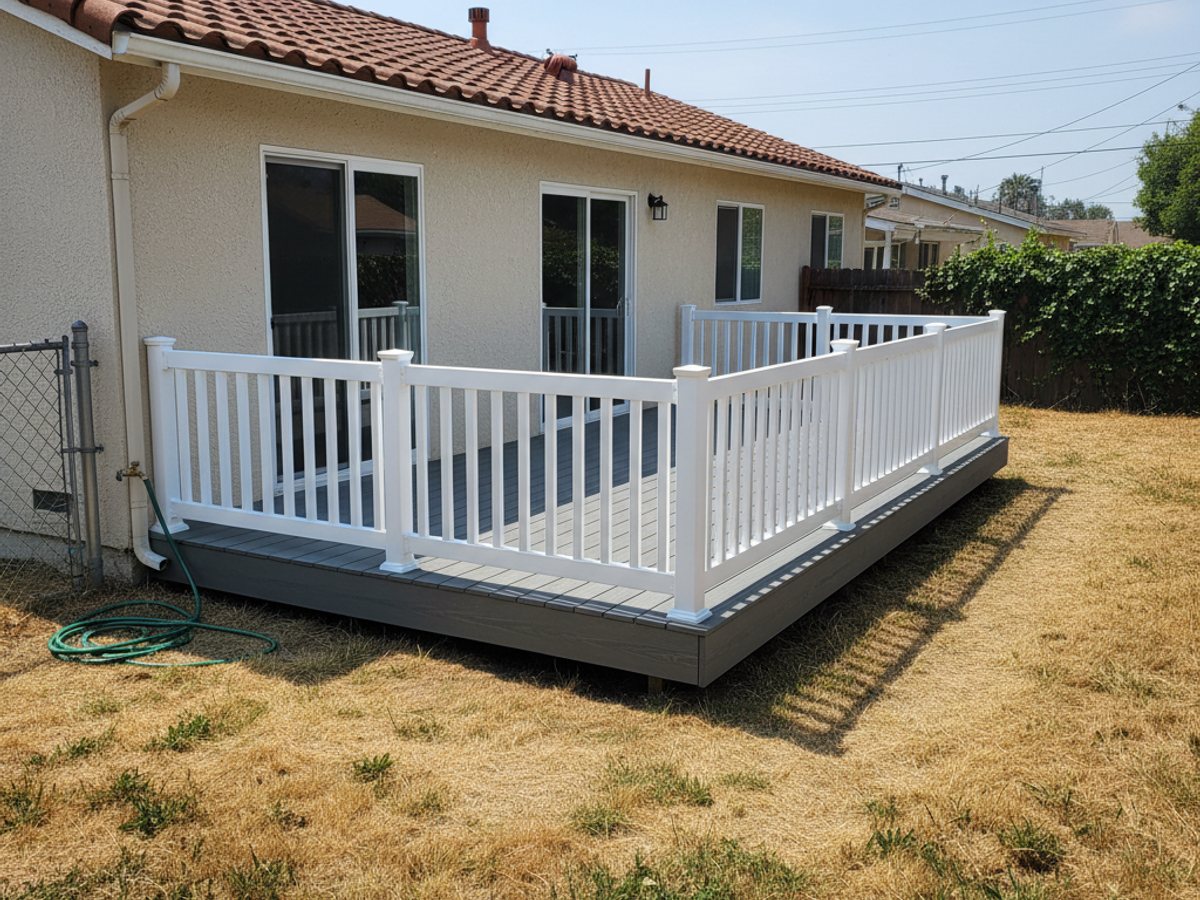
Palmdale sits in the high desert, and that changes what a deck actually has to survive out here. It's not the same job as building a deck in a coastal town an hour south. The wind alone will tell you a lot about who knows what they're doing and who's just framing lumber.
The ground under your deck matters more than the deck itself
Most lots in the Antelope Valley sit on decomposed granite or sandy soil, sometimes with a layer of caliche, that hard, cemented layer a foot or two down that a shovel bounces off of. It doesn't hold water like clay does, so you don't get the heaving problems you'd see in other parts of California. But it does mean footings need to go deep enough to hit bearing soil, not just stop at a convenient depth. A builder who pours a 12x12 footing 18 inches down without checking what's actually under that spot is guessing. Ask how deep they're going and why. "That's just how we always do it" is not an answer, because soil on a 1990s lot in east Palmdale can behave differently than soil three streets over near an old wash.
Older neighborhoods near downtown Palmdale, built in the 1950s and 60s, sometimes have fill dirt from grading work nobody documented. Newer subdivisions like Anaverde or parts of Rancho Vista were engineered lots with compaction records. A good builder will ask which kind of lot you're on, or at least dig a test hole before quoting footing depth off a plan.
Wind is the thing most out-of-town crews get wrong
Palmdale gets sustained wind that would make a coastal contractor nervous, especially through the passes in spring. That matters for railings. Code requires a guardrail to resist 200 pounds of lateral force at the top rail, and in a wind-exposed spot that's not a number you want a builder treating casually. Post spacing, the size of the lag bolts into the rim joist, whether they're using structural screws instead of deck screws at the connections, all of it adds up. A railing that wiggles when you lean on it is a liability, not a style choice.
Wind also drives sand and grit against fascia boards and under decking for years. Ask how they're detailing the ledger board flashing, because a poorly flashed ledger connection is the number one reason older decks rot from the house side out, long before the boards on top show any wear.
Licensing, insurance, and what to actually check
Any deck builder working in California above a certain contract value needs a C-13 or B license through the CSLB, and you can look up their number on the CSLB website in about thirty seconds. Do that before you do anything else. Ask for proof of general liability and workers' comp too, not just a verbal "yeah we're covered." If a crew shows up without workers' comp and someone gets hurt on your property, you can end up holding that bill.
A licensed contractor pulling a permit is also how the work gets inspected. In Palmdale, permits for an attached deck typically go through the City of Palmdale building division, and inspectors will check footing depth before the concrete goes in, framing before boards go down, and the guardrail and stair details at final. That two-step inspection process is annoying if you're in a hurry, but it's the only outside check that someone besides the builder looked at the framing. A contractor who tells you permits aren't necessary for a deck attached to the house is either wrong or hoping you won't ask again.
If you're in a neighborhood with an HOA, and a fair number of newer Palmdale tracts have one, get the design approved there too. HOAs care about railing style, deck height, and sometimes stain color. Skipping that step can mean tearing out a finished deck.
Materials, and how the desert treats them
Composite decking has gotten popular here for a reason that has nothing to do with trend. Wood decking in the Antelope Valley takes a beating from UV, more than in cooler, wetter climates, because you've got over 280 sunny days a year and summer surface temperatures on a south-facing deck that can hit 150 degrees on dark boards. Untreated or poorly sealed wood checks and splits faster here than most homeowners expect. If you go with wood, ask what stain or sealant they recommend and how often it needs redoing, because "every few years" in a milder climate might mean every 12 to 18 months in Palmdale sun.
Composite doesn't rot, but it does expand and contract with our temperature swings, which can run from near freezing on a January night to over 100 in July. A contractor who doesn't leave the manufacturer's specified gap at board ends and around fixed objects will end up with buckled decking within a year or two. Ask them directly what gap spacing they use and whether they've read the installation guide for the specific composite brand you're buying, because the gap spec is different across brands.
What to walk away from
- A bid that's dramatically lower than three others with no explanation. Usually it means smaller footings, 24-inch joist spacing instead of 16, or no permit at all.
- Anyone asking for more than a small deposit before materials are ordered. A large upfront cash request with no material list to back it up is a common warning sign in this trade.
- No written contract with a materials list, footing depth, joist spacing, and payment schedule spelled out. A handshake and a text message is not a contract.
- A builder who can't tell you, off the top of their head, roughly how many footings your deck needs and why. That number should come from the span and load, not a guess.
- Refusing to pull a permit, or telling you it's not needed for a deck over 30 inches off the ground. Decks that high trigger guardrail requirements and inspections almost everywhere in California, including Palmdale.
What a decent quote actually looks like
It should name the lumber grade or composite brand, the joist spacing, footing size and depth, how the ledger attaches to your house, and whether the permit fee is included in the price or billed separately. It should have a rough timeline, and for most single-level decks around here that's somewhere between one and three weeks from footings to final boards, weather and inspection scheduling depending. A multi-level deck or one with a covered structure on top takes longer, sometimes closer to a month once you add a pergola or roof framing into the mix.
We build and repair decks all over Palmdale and the surrounding towns, and we've dug enough footings out here to know where the caliche usually sits and what the wind does to a railing that's undersized. If you want a second opinion on a bid you already have, or you're starting from scratch, take a look at our deck builder work and give us a call.